






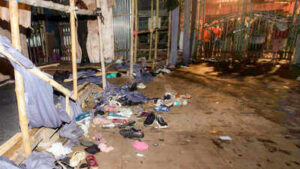


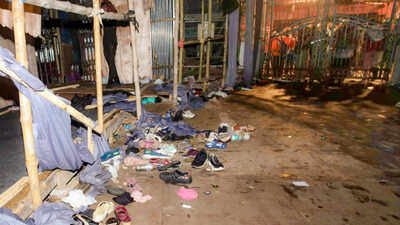
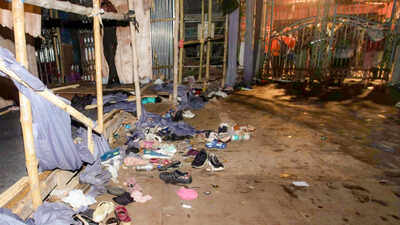
NEW DELHI: It begins with a rumour, feeds on panic and ends in tragedy. A stampede can turn a celebration into chaos within minutes, leaving thousands gathered in joy struggling to find a way out. In a tightly packed crowd, even a small disturbance can have deadly consequences.A similar script played out in Kolkata on October 17. On the night of Maha Saptami during Durga Puja, pandal-hoppers gathered in large numbers at the Chorbagan Sarbojanin pandal. The crowd swelled further after a sudden spell of rain prompted people waiting outside to seek shelter, while visitors near the exit stopped moving.An announcement over the public address system warning that the pandal was about to collapse added to the panic. Investigators believe several factors contributed to the stampede, including overcrowding, narrow entry and exit points, inadequate crowd management and the misleading announcement.
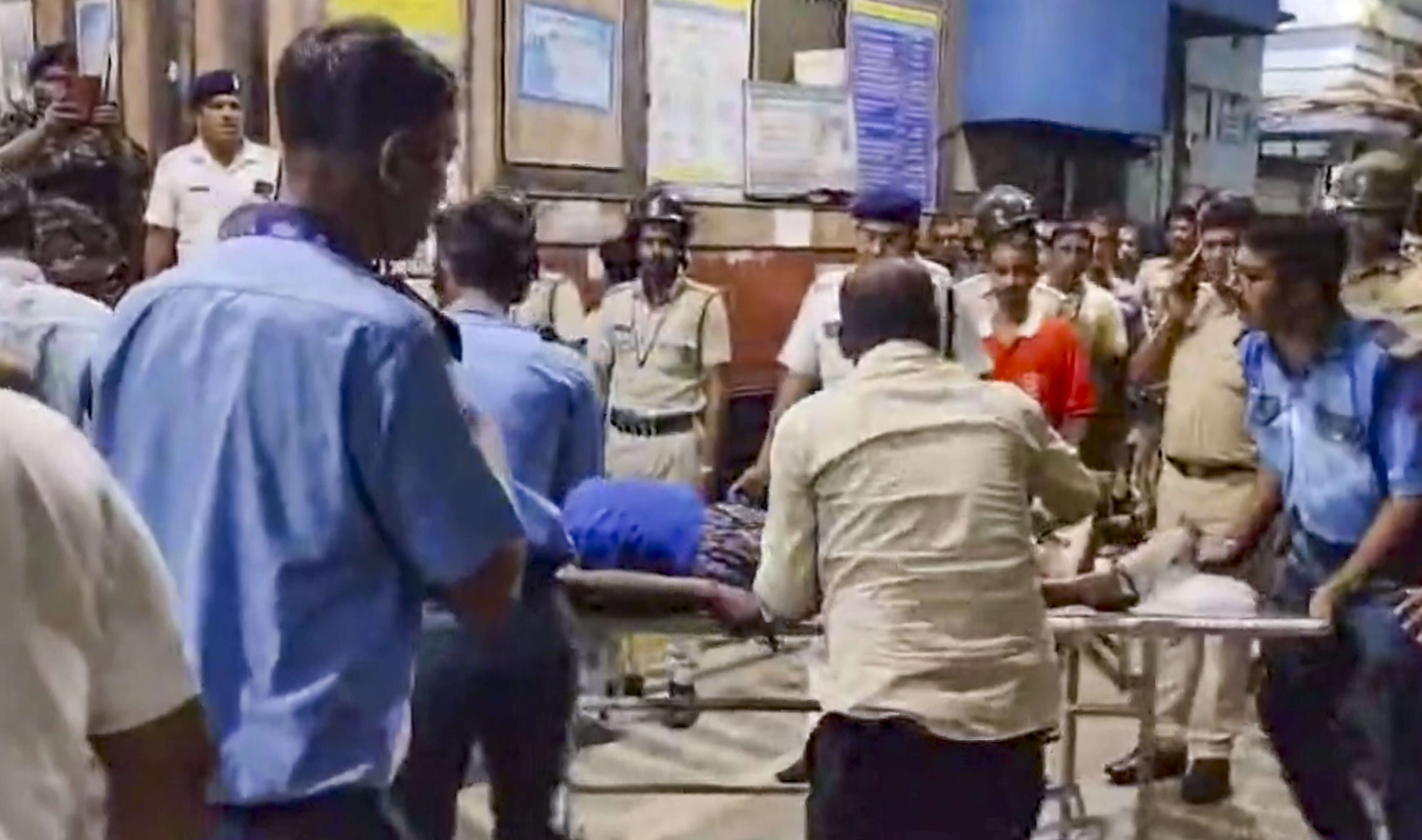
The crowd crush, which police said lasted around three minutes, claimed 19 lives and left at least 25 people injured.India is a country of festivals, and its massive religious gatherings also make it prone to stampedes. This year, it was Kolkata. Last year, it was Karur in Tamil Nadu and the Maha Kumbh in Prayagraj. The locations change, the crowds differ, but the tragedy keeps repeating itself.This raises an important question: despite elaborate planning and dedicated crowd management teams, why do stampedes keep happening? And what can authorities do to prevent a small disturbance from turning into a disaster?
The anatomy of a stampede
Public excitement soars during religious gatherings. Actual turnout often exceeds what authorities anticipate, resulting in more people entering an area than it can safely accommodate.As the crowd swells, even a small disturbance, a rumour, someone tripping and falling, a sudden power outage or even a broken barricade can lead to a situation in which people lose control of their movement.According to a 2014 report by the National Disaster Management Authority (NDMA), titled Managing Crowd at Events and Venues of Mass Gathering: A Guide for State Government, Local Authorities, Administrators and Organizers, crowd disasters can be triggered by several factors.Structural problems such as weak temporary structures, collapsed barricades, poorly lit stairways, slippery roads and narrow entrances and exits can lead to a crowd crush.
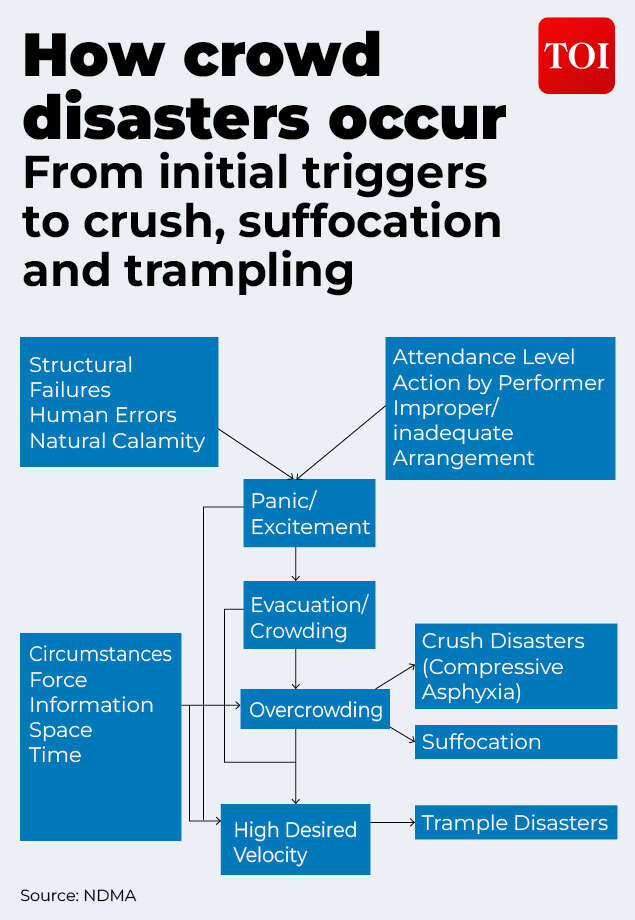
Fires, electrical failures and security scares can also turn an otherwise manageable gathering into a dangerous crush.The report explains the causes of stampedes through the “FIST” model which is an acronym for Force, Information, Space and Time. According to the model, the four factors that can contribute to a crowd disaster are the force exerted by the crowd, the information that triggers its reaction, the physical space available and the duration of the incident.“The FIST circumstances namely crowd force, the information upon which the crowd acts, the physical space involved, and the time duration of the incident play a very important role resulting in either overcrowding or high desired velocity,” the report says.In simple terms, when too many people are packed into a limited space, pressure builds as those behind continue moving forward while those in front are unable to move. At extreme crowd densities, people can be pushed against one another with such force that they lose control of their movements. Even those who remain standing can struggle to breathe.Deaths in such situations do not necessarily occur because someone has literally been “trampled” under the feet of others. The NDMA says compressive asphyxia, which occurs when pressure on the chest prevents a person from breathing, has historically been the most common cause of death in crowd disasters.“On occasions, this has led to deaths because of crushing, suffocation, and trampling. Historically, compressive asphyxia has been the most common reason for deaths in crowd disasters,” the report says.
Psychology of the crowd
Crowd psychology is also a factor that can contribute to a stampede-like situation. According to the NDMA report, individuals often conform their thoughts and behaviour to those of a larger group rather than acting independently.“Individual behaviour in a crowd is sometimes influenced by the behaviour of others. The individuals within a crowd may act differently than if they were on their own,” it says.“The unlawful actions of a few people can result in larger numbers following them. Research has shown that understanding of crowd behaviour has led to community based approach to crowd control instead of force based control,” the report adds.For instance, long queues at places of worship may lead some devotees to climb over fences, prompting others to follow and causing overcrowding in another area.However, crowd behaviour is not always irrational. People react to incomplete information, the movement of others and the fear of danger. In dense crowds, they may also lose the ability to control their own movement.This is why rumours and misleading announcements can be particularly dangerous. People may begin moving towards an exit without knowing what is happening elsewhere in the venue. If the exit is already congested, the sudden movement can increase pressure on those trapped in the crowd.
How should police act and react?
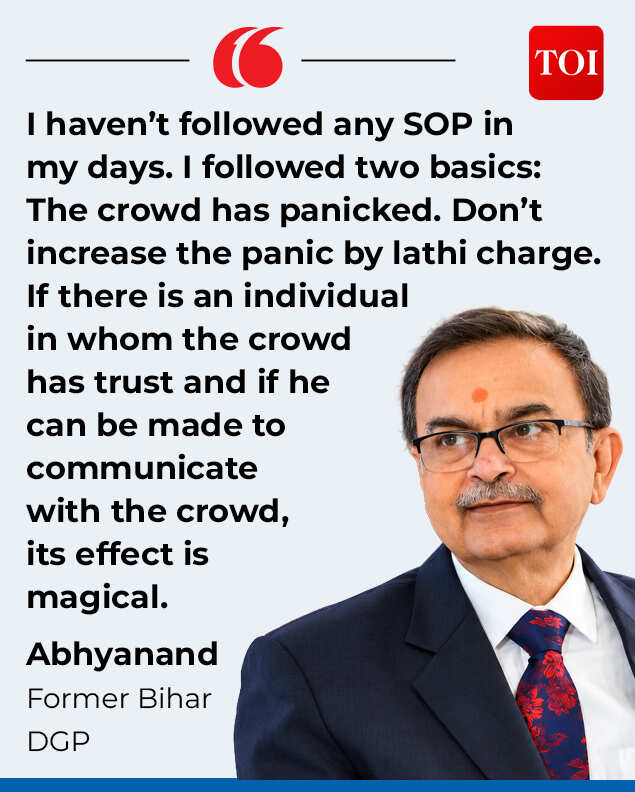
Talking to The Times of India, former Bihar director general of police Abhayanand, who handled several such gatherings during his long service, said police should refrain from using force when a crowd is already panicked during a stampede-like situation.“There is always a trigger, however small. It is followed immediately thereafter by a rumour which spreads like wildfire,” Abhayanand said.“I haven’t followed any SOP in my days. I followed two basics: The crowd has panicked. Don’t increase the panic by lathi charge. If there is an individual in whom the crowd has trust and if he can be made to communicate with the crowd, its effect is magical,” he added.
“Crowds where there is some common binding force experience stampede. Such stampedes are easier to manage,” he further said.Abhayanand also recalled handling a similar situation during the funeral procession of Ranvir Sena chief Brahmeshwar Mukhiya in Patna in 2012. He said police refrained from using force against a particularly unruly gathering of supporters.“The crowd was itching for a trigger, and a police lathi charge could have set things off. We restrained ourselves because the repercussions would not have been limited to the capital but could have spread across the entire state,” he told TOI.“Those indulging in arson wanted the police to react and resort to a lathi charge. That was precisely what they were trying to provoke, but we did not allow that trigger to be pulled,” he added.His account points to the importance of police response when a crowd is already on edge. An attempt to disperse people by force can worsen the situation if it causes them to rush towards a narrow exit or move against an incoming crowd.
Preparing for the unexpected
The NDMA has also laid down guidelines on how authorities should manage crowds and respond when a stampede-like situation develops.According to the agency, the guiding principle should be to bridge the gap between demand and supply. This requires controlling the number of people entering a venue, regulating the crowd within it and managing the outflow when necessary.The NDMA recommends designated staging points through which visitors should pass, along with effective systems to count and monitor people moving through them. Multiple routes should be encouraged to prevent bottlenecks and facilitate the movement of vulnerable groups.Crowd management also requires authorities to anticipate disturbances without allowing their response to trigger a larger crisis.“Such miscreants should be immediately quarantined and removed. Action should be taken immediately with tact and firmness, without inviting undue attention from the general public, which may be there if force is used,” it says.“Inappropriate or poorly managed control procedures may precipitate crowd incidents rather than preventing them. For example, police reacting to a group of unruly people may chase them in a direction opposite to the incoming crowd, which may create a collision, and hence a disaster. Special attention should also be given to the border of the venue and the floating crowd moving there because the mischief is usually caused at such places,” it adds.
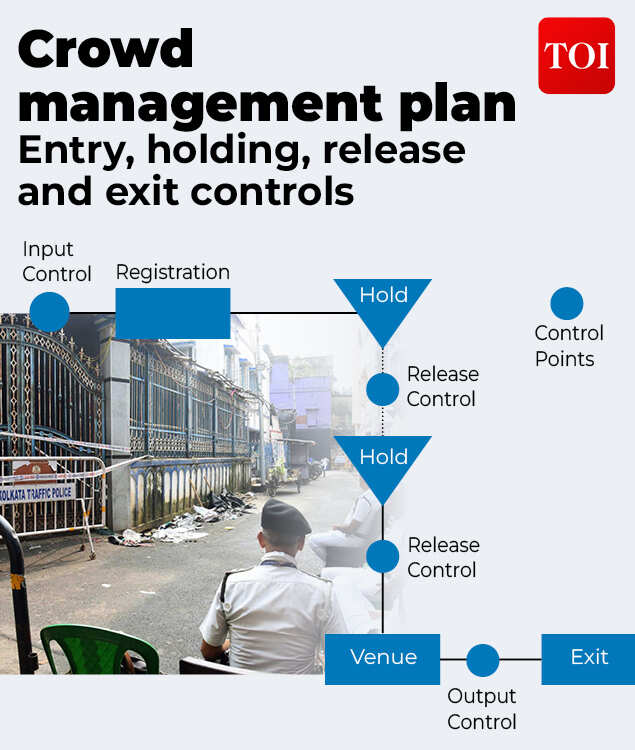
The agency also recommends “input control” by restricting or staggering entry to prevent overcrowding. Authorities must be able to regulate, slow or temporarily stop the inflow when a venue reaches its safe capacity.This also means keeping entry and exit routes clear, ensuring that people leaving a venue do not collide with those entering, and monitoring areas where crowds tend to gather or stop moving.Communication is another important part of crowd management. The NDMA says a lack of reliable information can cause people to panic or change direction, leading to dangerous crowd movements.“Communicating with visitors and providing them with the correct information is a very critical factor in all situations,” the report says, stressing that communication is essential during normal operations, emergencies and recovery.
Share your thoughts in the comments
Be respectful · TOI community guidelines
The Kolkata tragedy showed how quickly things can go wrong when these safeguards fail. Police said the crowd had become congested near the exit during the rain, even as the entry point remained open. The misleading announcement about the pandal collapsing is believed to have added to the pressure, although investigators are still examining the exact sequence of events.Ultimately, effective crowd management lies in anticipating pressure, regulating movement and ensuring that a small trigger does not turn into an uncontrollable chain of events. The challenge is not just to prepare for the thousands expected to attend an event, but also to recognise when a gathering is becoming unsafe and act before it is too late.