









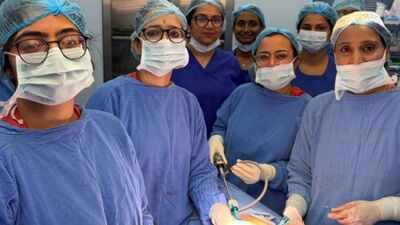
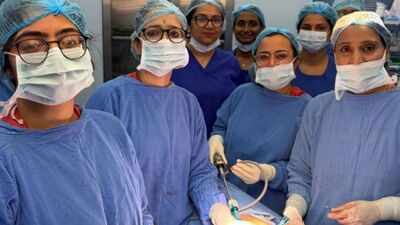
NEW DELHI: A 44-year-old woman, just 98 cm tall and weighing 22 kg, has undergone laparoscopic hysterectomy at AIIMS, with doctors adapting the surgical approach to minimise fracture risks from severe osteoporosis and address anaesthesia challenges linked to her exceptionally small stature.The woman, who has been living with osteoporosis, or fragile bones, since 2019, had suffered from extremely painful menstrual periods for nearly a year. The pain disrupted her daily life, forcing her to rely frequently on painkillers. Investigations revealed deep pelvic endometriosis and adenomyosis, a condition in which tissue similar to the uterine lining grows outside the uterus or within its muscular wall.Prof Neena Malhotra, head of Obstetrics and gynaecology said that the patient recovered well and was discharged on the third day after surgery.Given her age, bone fragility and high blood pressure, hormonal treatment was not considered feasible.Doctors recommended removing the uterus to relieve her symptoms. Teams from gynaecology, endocrinology and anaesthesia jointly assessed the risks before proceeding with minimally invasive surgery.“Minimally invasive surgery is now routine for most hysterectomies, but operating on an adult woman of this size, with severe bone weakness and hypertension, poses unusual challenges,” said Prof K Aparna Sharma from the department of obstetric and gynaecology.A major concern was positioning the patient. The conventional lithotomy position, in which the legs are raised and supported, could have exposed her lower back and thigh bones to fractures.“Due to short stature along with severely fragile bones, standard lithotomy position for hysterectomy could have put her at risk of lower back and thigh bone fractures. There was a need for utmost care in proper positioning and cushioning during surgery,” said Prof Rajesh Khadgawat of the endocrinology department.
Share your thoughts in the comments
Be respectful · TOI community guidelines
At the request of the patient and her family, the team opted to perform the procedure with her lying flat on her back, taking precautions to minimise injury.“The uterus was enlarged due to adenomyosis, and the uterus and ovaries were stuck to the adjacent intestines, while the space in her abdomen was very limited. We were able to complete the hysterectomy successfully through the laparoscopic route in around 90 minutes,” said Prof Reeta Mahey, who performed the surgery.