










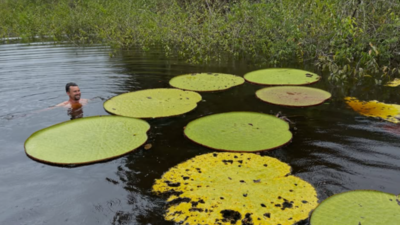
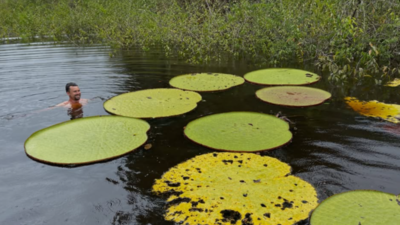
A casual Instagram post, a swim in a secluded Colombian lagoon and a team of scientists eventually revealed a remarkable botanical discovery. In 2021, plant enthusiast Jeremiah Harris photographed giant waterlilies in Colombia, assuming they belonged to a known species. Years later, those images helped scientists identify Victoria colombiana, a giant waterlily that had remained unknown to science despite potentially millions of years of separation from its relatives.
When an Instagram photo raised an unexpected question
In May 2021, Harris was exploring the flooded forests around Inírida, in Colombia’s Guainía region, with local guides and fellow explorers. Their boat reached a hidden lagoon where enormous floating leaves covered the water.The plants looked like the familiar giant waterlily Victoria amazonica. Harris photographed them, took a swim among the lilies and shared the experience on Instagram.But the location raised a scientific question. No Victoria waterlily had previously been recorded from the Orinoco basin. Carlos Magdalena, a senior botanical horticulturist at the Royal Botanic Gardens, Kew, noticed the photographs and began investigating.
A giant waterlily with clues of its own
The team used satellite imagery to locate more populations. The leaves were large enough to be visible from space, making them easier to spot across the remote landscape.However, identifying a new plant species requires more than an unusual photograph. Scientists must compare physical features and examine how the plant differs from known relatives.The team eventually documented distinctive characteristics, including a cube-shaped ovary with sunken sides. Its prickles were also shorter, denser and softer than those of some related giant waterlilies.These differences helped establish that the plant was not simply another population of a familiar species.
The race to find a flowering plant
The scientific investigation required fieldwork. Magdalena and his team travelled to Colombia to collect leaves and flowers, essential material for formally describing the species.Finding a flowering plant proved difficult. With their return flight to Bogotá approaching, the team faced the possibility of leaving without the samples they needed.Then, at around 11pm, boatman Gustavo Melo, from the Indigenous Tucano community, said he knew where more lilies could be found. The team travelled through the rainforest and reached a small lake shortly before sunrise.There, they found flowering plants and collected the necessary samples before returning for their flight.
What makes Victoria colombiana special?
The species are formally described in a 2026 paper published in Phytotaxa. Its floating leaves can reach 2.5 metres across, while its bright green leaves and softer prickles distinguish it from some relatives.Like other Victoria species, its flowers bloom over two nights, closing during the day between blooms.Its home also matters. The plant grows in the upper Orinoco drainage, a river system separated from the Amazon basin over geological time. The researchers suggest that changing river courses and long periods of isolation helped different Victoria species evolve.The study recognises five accepted species in the genus, including Victoria colombiana and Victoria mattogrossensis, identified in the Pantanal region.
A discovery that raises conservation concerns
The discovery comes with a warning. Estimates suggest only around 30 to 50 individual Victoria colombiana plants remain in the wild, potentially placing the species in the critically endangered category.Researchers are working with Indigenous communities to collect seeds and study ways to grow the plant under controlled conditions. One proposed approach involves establishing a protected lake that could also support carefully managed ecotourism.The story also is a reminder about botanical exploration. Indigenous communities and local guides often hold detailed knowledge of landscapes that remain difficult for outside researchers to reach. Their contributions are essential to documenting and protecting rare plants.A photograph shared for its beauty ultimately helped reveal a species previously unknown to science. The lagoon had held its secret in plain sight, waiting for the right questions to be asked.Disclaimer: This article is based on the supplied research summary and study details. Population estimates and conservation status should be interpreted in light of further assessment and ongoing research.