






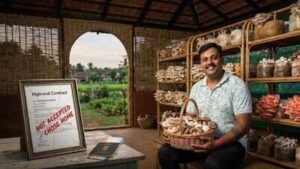



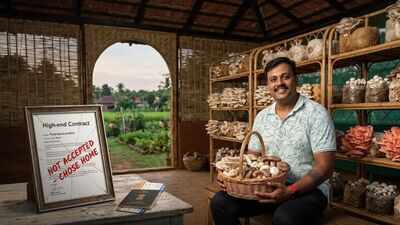
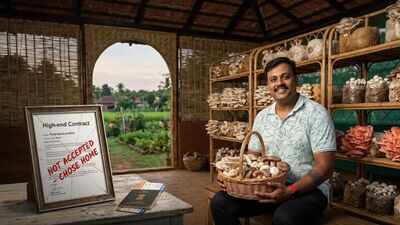
A master’s degree from France, job offers in Paris and the prospect of an international business career gave Prithviraj several conventional paths to success. Yet the Bengaluru entrepreneur chose a different direction. He returned to India, took a second look at his family’s abandoned poultry shed and began exploring mushroom cultivation with a tiny experiment costing just ₹180.That decision has since grown into a commercial oyster mushroom farm in Devanahalli, on the outskirts of Bengaluru. According to reports by Navbharat Times, the operation has expanded to approximately 4,000 growing bags and produces around 45 kg of mushrooms daily. The reports estimate monthly revenue at close to ₹4 lakh. His story is not simply about leaving a foreign job behind. It is about recognising the potential of an unused asset, testing an idea on a small scale and understanding that growing a crop is only one part of building a viable business.
From a French business school to a forgotten poultry shed
Prithviraj completed his master’s degree in international business at France’s SKEMA Business School. Although he received job offers in Paris after graduation, he decided to return to India and pursue entrepreneurship instead of entering a conventional corporate career. Back in Devanahalli, he had access to something that could become the foundation of his venture: his family’s old poultry shed, which had been closed since 2019. Rather than immediately building a new facility, he considered whether the existing structure could be adapted for mushroom farming.The idea had first caught his attention in 2019, when a friend introduced him to mushroom cultivation. After returning to India, he explored the practical requirements of the business and received training to improve his understanding of production.He eventually settled on oyster mushrooms rather than button mushrooms. According to the reports, he was drawn to their comparatively straightforward cultivation process and lower initial investment requirements. The old shed offered a potential cost advantage, but it was not automatically ready for mushroom production. The space needed modifications to support cultivation. Moneycontrol reported that he invested around ₹2 lakh in adapting the facility, a figure that puts the ₹180 experiment in perspective: the first trial was inexpensive, but scaling up required additional investment.
How ₹180 became the starting point for 4,000 growing bags
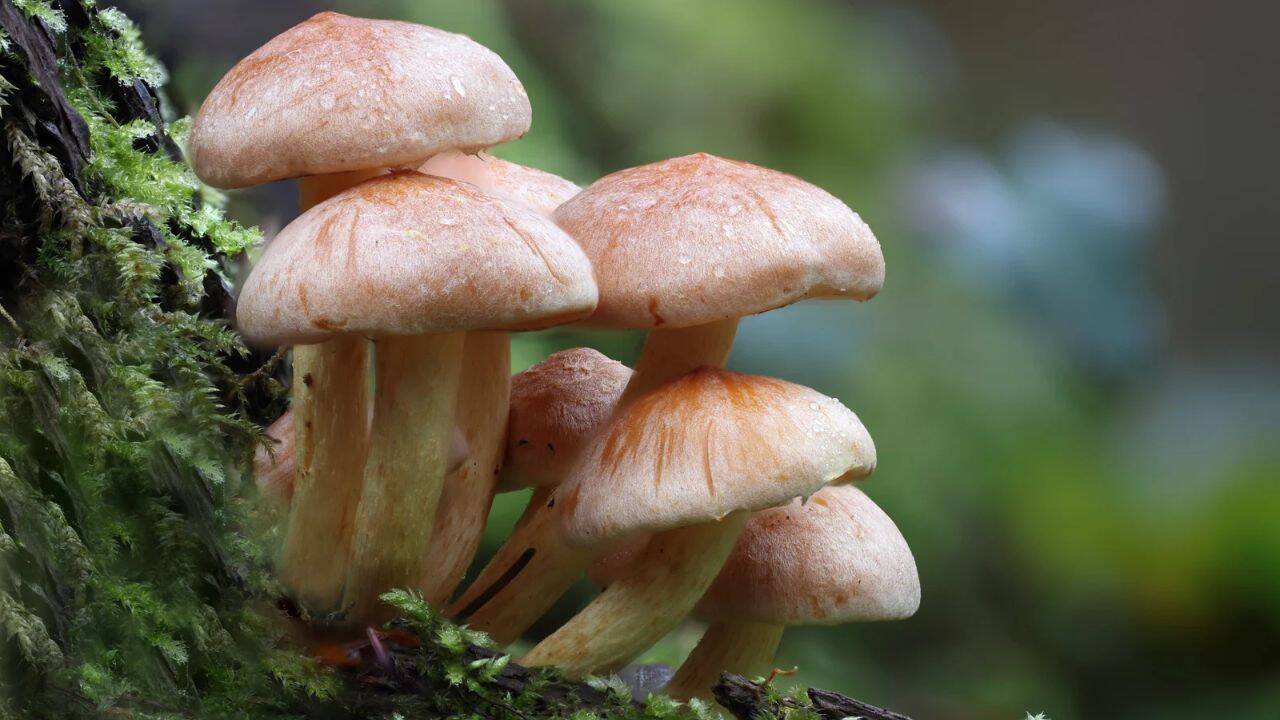
In January 2025, Prithviraj began with two kilograms of oyster mushroom spawn costing ₹180. He used paddy straw sourced free of charge to prepare 10 growing bags. The first harvest arrived after approximately 22 days and yielded around eight kilograms of mushrooms. Instead of immediately treating the result as a business, he distributed the harvest among friends and relatives. The trial gave him an opportunity to learn from the growing process and assess the results before committing to commercial production.He began selling commercially in March 2025. Reports say the operation initially expanded to 25 bags before growing to approximately 4,000 bags at different stages of cultivation. Today, the farm reportedly produces around 45 kg a day, equivalent to roughly 1,350 kg over a 30-day month. At an average selling price of ₹320 per kilogram, that volume would translate into approximately ₹4.32 lakh in monthly sales if all the produce were sold at that rate.The distinction matters because reports describe the figure as monthly income or revenue, but these terms are not interchangeable. Sales revenue is the money received from selling mushrooms before deducting expenses such as labour, electricity, packaging, transport, maintenance and other operating costs. The available reports do not establish the farm’s net profit. Prithviraj’s customer base reportedly includes local vegetable markets, supermarkets, retail sellers and quick-commerce platform Zepto. Supplying organised retailers and delivery platforms can create access to wider markets, but it also requires growers to meet purchasing, quality and delivery requirements.
Making the business work beyond cultivation
For Prithviraj, expanding production is only one part of the challenge. Mushrooms are perishable, so reliable buyers and timely distribution matter alongside successful cultivation. A grower who increases output without securing a market may struggle to sell the harvest before its quality deteriorates. He has also explored ways to use the material left over after mushroom cultivation. Rather than discarding the spent growing substrate, he uses it for composting and vermicomposting, creating manure that can provide an additional revenue stream while helping reduce farm waste.As the venture has developed, he has begun training people interested in mushroom farming. His approach extends beyond explaining how to grow mushrooms to helping aspiring growers understand marketing and identify potential customers. That emphasis addresses a common challenge in agricultural entrepreneurship: production skills alone do not guarantee a sustainable business. Growers also need to understand costs, maintain consistent quality, find buyers and plan how their produce will reach the market.Prithviraj’s journey from international business studies in France to a mushroom farm in Bengaluru shows how an unconventional career decision can develop into a commercial venture. The ₹180 trial was an entry point, not the entire investment. What followed involved adapting infrastructure, learning the crop, building production capacity and developing sales channels. For anyone considering a similar path, the central lesson is to start by testing an idea, understand the full costs before expanding and investigate demand before increasing production. An unused building can provide an advantage, but success still depends on practical knowledge, careful management and a market willing to buy what the farm produces.